 |

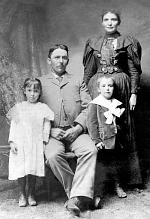
 The Buzby Family – An Alaska Pioneer Family A A AFaces of Alaska: Elton BuzbyThis article is from Faces of Alaska: A Glimpse of History Through Paintings, Photographs and Oral Histories © 1988 by Jean Lester, all rights reserved. Reprinted here by permission of the author. 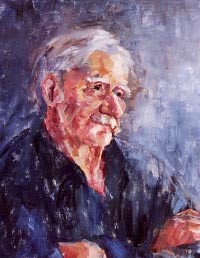 I don't know as, unless on special occasions, that we've ever ate so good, laughed, sang and played music, with quite the emotion that we did when we was young. In the early days, in the winter time, traveling was mostly on the rivers. Built up ice, y'know, so that it would hold heavy equipment for wood hauling and various other things. It put a lot of people to work. Steamboats had to have wood to operate up and down the river. Then were many, 'many people engaged in cutting wood and piling it on the edge of the bank, hoping the flood wouldn't carry it away before the steamers could get it. People were different then, too. It was a period when people were concerned about each other, neighbor helping neighbor. Now some are concerned, but it's not the same. My Dad, he came up to Nome before the storm of 1900. He fell into the Fairbanks area in 1905 and it's been our home ever since. My Dad was interested in mining, of course, that was his main reason for coming north. He came into the Circle country in 1903 from Skagway out from Dawson, and worked for the Berry & Hamlin people. He hunted for them because the only way they had to survive was eating wild meat. Then he came into Fairbanks. He put a pack on his back and started from Cushman Street, where the bridge is, and headed for the hills, putting in a trail for a double-ender. A double-ender was a sled thirty inches wide and it had a turn-up at each end. It was flat and you could hook a rope between two or three and handle about two hundred fifty to three hundred pounds on each. One horse could take as many as two, three, or maybe four double-enders and stay right up on top of the snow. He made that Bonnefield trail over to the Alaska Range for the Berry & Hamlin people. They mined in the Gold King area until the flood of 1912 or 1913. Then all that area down there was flooded. Water filled in all the creeks and everything else, and washed Red Rodger's quartz mill on the Wood River right off the hill. There was nothing salvageable left. Then that country grew back and the first time I was out there, you'd never know there had been anybody around. In the early days, we had one of the first fur farms. We had mink, and tried raising marten, and we had lots of foxes. My Dad bought live furs for stocking the Alaska Silver Fox and Fur Farm in Lake Placid, New York. We learned how to buy, and spent quite a lot of time going all over Alaska buying fur.
We always had lots of horses and other stock, so we had to learn about taking care of stock and feeding it. It was quite a chore. In the early days they used to drive stock in from Valdez, live, into Fairbanks where they had a big slaughterhouse. That was the only way to get fresh meat. They would have regular drives; a cattle boat would come up to Valdez, and then they'd drive 'em in. When they'd get here they'd have a lot of horses that the boys used for riding, some of them good and some of them not so good, and they'd hold an auction. We'd always take what money we had as kids and go down, and if a horse came up for bid we'd bid five dollars and eventually we'd get one. 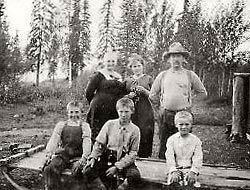 We were kind of fortunate growing up. We had a very close family. I had three brothers and two sisters, and a mother and dad who had gone through many experiences and who had a great interest in everything. But the family was most important, and anything they knew was available to you for you to accept or reject. One of the most fortunate incidents when we were kids is that we had three very great teachers, and they came to our home to teach us. Professor Hoppe played the violin and piano. He had taken up a homestead here in Fairbanks right next to us after many years of sailing and wandering, and we met him at that time. I took eight years of music and altogether twelve years of instruction from him, coming into our home once a week. And there was another chap, Dr. Britt, who was a physicist and interested in archeology as a sideline. Then there was Professor Pfiffer, a physicist, who was the third remarkable man. You've got to be interested in all sorts of things to stay alive. Why, I remember Professor Hoppe doing experiments with mulches and playing music to his plants, and he grew wonderful stuff. And there's another acquaintance we have who will never plant a seed without asking the Lord to bless it first, and his plants always grow. We haven't scratched the surface of what there is to know. And we learned quite a bit from all the people we were around. It's kind of like handling money in some state agency in Juneau, it's awful difficult if some of it don't rub off on you. Later on we went outside for a bit, and I went to school out there for five years. Then we cut loose. I was about seventeen. We were going to take part in the railroad colonization plan. They were going to start a creamery here and make cheese, and colonize along the Alaska Railroad. So I took jobs in several creameries there in Oregon, learning everything from how to make cheese to how to build the boxes to put them in. Then we got together a carload of stock to bring north. 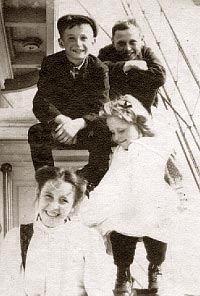 We came by steamer to Alaska. It was an awful trip. They were supposed to have accommodations for the cattle under the colonization program, but there were no preparations. We had to hire a bunch of people coming up on the boat to help us water the stock as we had to carry small buckets of water from the crews quarters to where it could be lowered down the hatch to the cattle. It was a nightmare. Then, through political action, the railroad program fell through, and with it the idea for a creamery, in favor of the colonization of the Matanuska Valley. All this happened while were enroute with the stock. When we got off the boat, we found that it was going to cost us an additional $5,500 to bring the cattle into Alaska, the cheaper rate being discontinued when the railroad colonization plan was abandoned. Then we had to get the cattle home. The problem of water started again the moment we got off the boat in Seward. It was winter time and the railroad gave us two stock cars with slats. Good to see out, with lots of fresh air, but colder than hell. And we couldn't get the railroad people to stop at a spot where we could water. It took us three days to get from Seward to Fairbanks with the stock, and I've been against regulators and bureaucrats ever since. There were many experiences then that made a fascinating life for me. There were always opportunities in Alaska, and there's more opportunities today than there's ever been. It's just very few people take advantage of them. 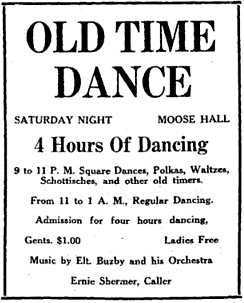 We had a dance band one time. That was in the early thirties. We'd play once or twice a week because that was about all people had to do here. Nobody had much money. It was during the depression, and everybody just tried to be happy and have as much fun as possible. We got a few good musicians together, and ended, up with an eleven-piece band that put out music you couldn't help but dance to. We've not always had enough money. I was caught in 1934 in Seattle. I'd gone out to buy a bunch of supplies. I got everything ready to go, and a strike was pulled down there. And that was our only transportation, that once a week ship. So I ended up there over two months and toward the end I was getting desperate. I ended up coming north on a navy ship. I happened to hear an announcement on the radio that the President was going to authorize a ship to go to Alaska to carry the mail during this strike. So I got to Bremerton Naval Yard and explained my situation to the Commandant. It just happened that my brother and I had this property over where Fort Wainwright is now and we had a float plane field where people like Wien, Pan American and the others could land. We'd put it in for Pacific International, Howard Hughes' outfit. It was the only thing I could think of so that they'd let me on, and it was legitimate. So the radio man got in touch with the Secretary of the Navy, and they got a telegram saying I could go.
These things are a part of life, legitimate trade-offs. Now, if you'd gone out and tried to bribe them to take you, then you'd be no better than a politician. And this goes back to family, and how you're raised. It's the values you learn when you're young that usually carry over throughout your life. Guidance is so important. It's the family's responsibility not only to keep the kids healthy, but to do the educational type guidance that affects them when they grow up and become adults. The important thing then, when you have the responsibility of a child, is to do some real deep thinking and planning. I don't mean material planning. A lot of people worry about money and anytime you worry about a thing, why you're vulnerable, y'know. If you don't worry about money too much, your needs will be met. Always seemed that way with us. We've been desperate at times. I remember once just after we moved to the property out here, job I had unexpectedly gave out. So going into winter, we didn't have any money. Things was kind of bad, especially near Christmas time. Then out of a clear blue sky, I remembered I had a payment to make on a tractor we'd bought. The day before the payment was due, two chaps came in here and plunked down more than enough money to take care of our needs, for future work to be done. Now it's kind of startling to have those things happen, and if you was worrying much maybe they wouldn't have showed up. It takes a kind of atmosphere to make this happen. And this has happened not just this once but in other areas too. The only thing I think that saved us from being very frightened was influence from the family, that the Lord was going to take care of you if you'd just hold up your end.
We have a sort of unique little deal here. Betty and I were married in 1939 or '40 and we bought this land so we'd have a place to spend the summers and not be in town. We had four kids, two boys and two girls; and the kids helped build the house and had a great interest in it. Then we all liked it so much we decided we'd stay here. That was in 1951 or '52 and we've been here ever since. But the point I'm trying to make is that if kids have an interest in what you're doing, and you let them help, even if it's not the greatest building, they've done it and it means something to them. It's an attitude that shows family cooperation, and this can be lasting. You can't dictate to your kids, y'know, don't try to run their lives, don't try to keep them there in the house if they want to go out and do something. But have conditions so that it would be preferable for them to be home. I think if I were to try to explain the most important events of my life, it would all hinge upon what the family as a unit was doing. Some of the instances probably weren't too good, could have been better, but they'd have been a lot worse if we hadn't had that closeness. A lot of people say "Well, I don't know what I'm doing here on this earth." Well, I think everybody should ask themselves that, and try and find the answer, too. Back to the top
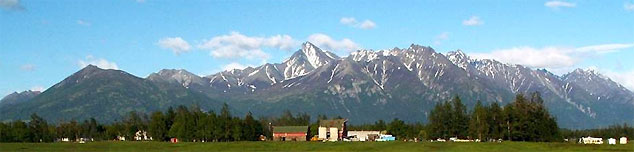
Matanuska Peak photo courtesy of Teressa Van Diest |
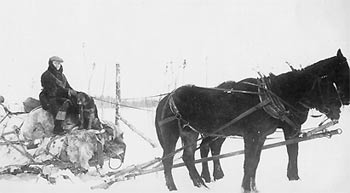 We learned about raising a garden, too. We had one of the first homesteads that was ever taken up in Fairbanks, out where Fort Wainwright is now. We cultivated wild berries and had a big cellar where we kept produce all year round. It was always full and we always sold some produce, too. We'd hitch up a team of horses, load the wagon with vegetables and head out to the mining claims, out toward Chatanika. We'd always sell out before we'd get to Chatanika. We'd meet just hundreds of people. There were thousands of people out there mining then. I was about six years old when I made the first trip and that would be about seventy years ago. It was a long, muddy damn trip, y'know, with those horses.
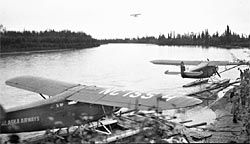 Twice something like that has happened to me, and to be Outside and run out of money is something that is very, very difficult. It happened again in 1938 and I was quite fortunate by getting transportation because of the use of our airport again. Wien took me to Valdez and Cordova. Damn near froze to death. I was the only passenger on a trimotor Ford airship. Noel Wien was pilot and Jimmie Stewart co-pilot. Of course, they wouldn't take any money for my fare because they used our field.
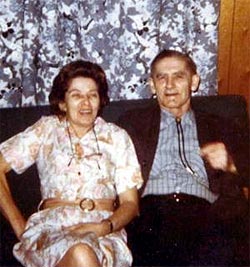 And that's why we do gardening, to contribute our share. That means you've got to prepare some ground, take care of obnoxious weeds, see it has a little moisture, and harvest it. Then if you can't use it, give it away. But there's that contribution you have to make and you have to be willing to accept it. Forget about the little worries and remember that there is something far greater to look forward to, and try and be a part of it.