 |

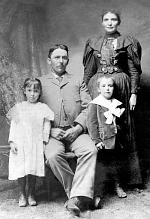
 The Buzby Family – An Alaska Pioneer Family A A AEarly Days in Montana – Reminiscence by Harry BuzbyThe writer, then a young man, passed the summer, fall and winter of 1879 in eastern Montana - then a territory - in the Yellowstone River Country - now Dawson and Custer counties. During that summer I became acquainted with a man John Montigue by name who had resided in that country since shortly after the close of the Civil War, having served through the war in a Wisconsin Regiment. His dwelling place was a dugout 16x40 feet built in the bank of Spring Coulee near good water and a grove of box-elders and ash. The dug-out was divided into a dwelling house and a stable. He always kept a saddle horse in the stable when at home with which to round up his other horses and as a further protection against Indian and white horse thieves. He was the only white settler in that part of the Yellowstone during the first six or eight years of his residence in Montana. His place was noted for miles east, west, north and south, as a haven of rest, a place where one could obtain "grub" at all times; what may seem strange, is that during all that time he was only robbed but once of anything of any value. That once was by a young scalawag that had come to his place sick and hungry. He stayed long enough to become well and fatten-up and when he left he took as companions four horses, blankets, guns and $80.00 in cash, the latter Montigue had left in his charge while away on a trip to Ft. Buford. The young Rascal made a good get-away with his plunder too. Here situated six miles east of the confluence of the Powder and Yellowstone Rivers, two miles south of where the town of Terry was located at the time the Northern Pacific R.R. was built I first made the acquaintance of John Montigue. I was very fond of adventure in those days and to me Monty was the real kind of man in my estimation and it was not strange that a mutual like sprang up between us which fast grew to warm friendship. He invited me to spend the winter with him hunting Buffalo. It was his occupation during the winter to hunt these animals for their hides which were of good commercial value. Buffalo huntingAt that time the last large herds of Buffalo were in the western part of Dakota Territory, east Montana and as far north as the Canadian line. Hides killed within 100 miles of the Yellowstone or Missouri Rivers could be handled profitably. The hunters would outfit at the trading posts on the navigable streams, move into the winter feeding grounds of the Buffalo, make a headquarters camp and hunt the surrounding country. The mode of killing was peculiar. Having located the herd of Buffalo, approach under cover against the wind was made until within range of from 300 to 500 yards. The hunter then endeavored to shoot the leader or first one through the lungs, in which case it would lie down almost immediately. If this happened and the herd did not stampede, the chances were good for a killing according to the number of animals in the herd. If they moved away the only thing to be done was to keep out of their wind and wait patiently until they could again be approached unless they took a notion to travel too far away from camp, in which case it was profitable to take a two or three weeks outfit of "grub", tent and stove and follow them i.e., if they were large enough to warrant a good big killing. Most of the rifles used by the professional hunters were Sharp 45 caliber, shooting 110 or 120 grains of black power and 400 grain bullets of soft lead, such gun weighing from 14 to 18 pounds and would shoot clean through a Buffalo at 600 yards. The greatest trouble was the smoke and the report - for those guns could be heard ten or twelve miles away. To avoid making too much smoke, slow shooting was necessary. It was customary to carry a wiping stick along and wipe the gun after each such shot, thus keeping the gun clean and cool all of the time. After a killing had been made the skinning followed; each hide was folded up with the hair inside and left on the prairie until the freighters came for them which might be a few days or months as the case might be. Each hunter would mark or brand his hides with a private mark, which mark or brand was respected by all the other hunters. With the approach of spring, killing was suspended and the accumulated hides were sold to the buyers. Often contracts were made in the fall for the winter killing at so much a head. At the time I came upon the scene the average price paid where the hides were killed was from $1.50 to $2.00 per head, according to the nearness to navigable water, the meat was considered. After the northern Pacific R.R. penetrated the Buffalo range, hind quarters of fat young cows, well handled, would bring about 2¢ per lb. delivered at the R.R., which price was about what it cost to freight it from the killing grounds. The meat was shipped to the eastern markets - mostly to New York where we were told it brought fancy prices. A winter killing and skinning for one man averaged about 500 animals. Some hunters hired skinners and did nothing but the killing. One hunter, Doc Zoll by name, shot 3700 Buffalo the fall and winter of –79. He kept a good sized crew of skinners and camp rustlers busy all winter. On one occasion he killed ninety six animals at one stand. Preparing to huntBut to resume. Monty and I began to kill black-tail deer in Oct. The deer were plentiful in the breaks of the Yellowstone so that hunting then was a profitable undertaking - dried venison being a standard ration among the hunters. About November 1st we loaded our winter's outfit into a good stout wagon and pulled out for the divide between the Yellowstone and Big Missouri Rivers with four good horses which would work in the harness as well as under the saddles. On the headwaters of a stream called Redwater, Montigue had a good dugout - house and stable combined as was his wont. All of that country was covered with a thick growth of Buffalo and bunch grass. It is a high plateau country interspread with small abode buttes and some high hills - one of the finest grazing grounds in North America and had always been a favorable wintering spot for Buffalo, so Monty told me, and which later events proved correct. Crossing the Yellowstone at an old Indian crossing about three miles below the mouth of O'Fallon Creek we struck out in a northeasterly direction. We reached Mont's winter camp at the end of the second evening and the following day we hauled wood and straightened things out for housekeeping. Antelope were seen at all times in those days and were considered a nuisance by Buffalo hunters - often alarming the Buffalo by their crazy actions when one was crawling onto the game. On one occasion I shot into a bunch of them that persisted in hanging around and pretending to take a great interest in my business. I killed three with one bullet - only a small incident to show in what numbers they congregated. The camp being in order we saddled up to reconnoiter for Buffalo and to acquaint me with the lay of the country - our custom was to keep one horse in the dugout every night hobbling the other three and keep taking turns with them. We had no hay but a few sacks of oats for emergencies. Our stock kept in fine condition summer and winter on the native grass. The first herdDuring the first five or six days we saw only a few old bulls with which we did not bother. Monty said the herd would feed on down from the northwest. Accordingly about ten days after our arrival at camp I rode twenty miles or so northwest toward a high ridge called Little Sheep Mountain. With my field glass, which was carried strapped to the saddle, I noticed Buffalo five or six miles away in the Valley of Cedar Creek. Riding still farther up the divide until I could see a big flat several miles in extent and to my delight I beheld thousands of our game scattered all about. It was my first sight of a great herd and my readers can imagine how my blood warmed at the display. I would not at that moment have changed places with the president or a king. They were grazing and lying about as far up the valley and surrounding hills as I could see. After a good long look I loped back to camp to gladden Monty's generous heart with my news. His advice was to let them alone until a good portion of the herd was within two or three miles of our camp. Then if they worked out as he expected they would, we would have plenty of work cut out for us. Two or three days later the herd came into our neighborhood. We killed a two year old heifer close to camp. The flesh we used for food for there was never better meat than a fat young Buffalo cow. Soon there were sufficient numbers to the north of our camp to warrant a killing in earnest. Monty had ideas of his own about every detail of the business. I being a much younger and inexperienced man of course deferred to his wish. I remember the morning we started out to kill, the air was clear and rather cool; we were posted on the rim of a flat that extended north and east for several miles down one fork of the Redwater. Here at least 200 buffalo within shooting distance of us and several thousand in sight to the north, northwest and east. The wind coming from the northwest everything seemed to be in our favor. I could see that Monty was a bit nervous and my blood was running at fever heat. Monty fired at an old cow standing about 400 yards from us - the shoot was a clean one going clear thro' her lungs. She humped her back up for a few minutes, walked a few yards and lay down. The others had turned at the sound of the shot but seeing nothing they remained quietly feeding. The cow being down Monty shot at a big bull near the cow, but that shot was a little too far forward and high striking the animal well up In the shoulders. He collapsed at the crack of the rifle kicking for a few seconds. The others near by seemed somewhat surprised by his actions altho' they did not seem frightened. Monty told me to go to there but to shoot slowly while he dropped back from another cover a short distance away. Our saddle horses were behind us pinned down at the end of their ropes for it was always safer to keep ones horses close by. A man on foot on the plains was rather a weak proposition. By the time the sun was two hours high we had downed about twenty five fellows on a space of not more than two acres - and the others still remained. Those who did move away were replaced by others. It was a strange thing, that has often been remarked, how little attention buffalo paid to the odor or sight of blood - exactly opposite to domestic cattle. The stampedeWe were congratulating ourselves on our bright prospects when we noted a commotion among the animals a mile or more away to the northwest - within two minutes time that vast herd was in motion like a great army, moving slowly at first and then faster and faster until they were in full flight toward the east. What a great stampede it was! At the first movement we had pulled our field glasses and soon discovered the cause. About twenty five Indians riding light and carrying guns had cut into the herd two miles northwest of our position. They were coming our way driving that portion of the herd that was on that side straight toward us. Not a shot was fired and there was no sound save the hoof beats of the fleeing animals. As soon as Monty saw how things were situated he hurried over to my stand and secured his horse. I did likewise, then we began firing as fast as was possible as the buffalo passed us. The Indians flying their blankets to frighten the animals passed about 200 yards In front of us. Monty said they were Yankton Sioux from the Poplar Greek Agency on the Big Missouri River. They had been sent out to stampede the great herd toward the Yellowstone flats toward Ft. Buffalo. The real hunting party was, no doubt, waiting 30 or 40 miles northeast of our camp to take the Buffalo after they were well run down - then a grand killing would ensue and the whole tribe live fat for the balance of the winter. Such was the Indians way - a big medicine dance - a big drive and then a big killing - heap big feed and a big sleep. It was a grand sight to witness flying, silent, wild animals pursued by the just as wild a Indians - all a part of a wild country. I have never forgotten a single detail of those days. I was probably not as much disappointed as Monty was at the sudden termination of what appeared to be our big killing - he looked at it as so much money lost which was no doubt the right way after all. After dinner I started skinning while Monty rode to the N.W. to see if all the buffalo had indeed quit the country. I had learned the butchers trade before coming to the plains and was at home with a spinning knife - altho' skinning a buffalo bull that weighed close onto a ton was no child's play. Monty reported no Buffalo in sight on his return in the evening. After finishing skinning the few we had killed he said we would take two or three weeks grub and pull out for the herd on Cedar Creek, thirty miles N. W. The next day was cold and snow a little. We hauled the hides into camp where we stacked them for future disposition. The cold snap over we started on our proposed trip. That first afternoon we again sighted buffalo - seven being in one bunch and thirteen in another. We camped in a grove of cottonwood in the lee of a hill where a good running spring issued from its base. The next day beginning blustery and cold ended in a blizzard so that we were forced to stay in camp. By keeping our sheet iron stove red hot we managed to be comfortable - but our horses pawed the snow and shivered, their backs humped to the wind. The cold was intense the following day; the wind slacked off so that on the third day there was a great change. A chinook began blowing from the west and the snow thawed rapidly. We took a look around as soon as it became light and were pleased to see several small bunches of buffalo. We got busy at once and by night had several hides rolled up to our credit. We remained at this camp until a few days before Xmas and had piled up between 350 and 400 hides. We drove to the main winter camp and from there to Fallon where we spent our Xmas holiday together with a few other hunters and freighters. A man, Gifford by name, coming to Fallon from the Black Hills across country reported plenty of Buffalo eight miles south of the Yellowstone. We decided to pull for that part of the country, our luck not having been the best on the north side. Two other outfits accompanied us. We found the buffalo alright, also a good sod and log cabin which had been built the year before. The other outfits went into camp a few miles distant, this being most satisfactory to us for in those days the country was rather of a dangerous character. Indians were very plentiful. They had great respect for the "buffalo guns" and seldom molested the hunters even when they would attack a wagon train, for they were aware the hunters were always on guard and had plenty of ammunition constantly on hand - also that one buffalo man was sure to kill several Indians - the game was too dear unless of course the odds were great against the hunter. "In numbers, therefore, was safety." Getting to work at once we had fair success until in March at which time we gathered our hides together preparatory of breaking camp. Montigue was a fine companion, full of yarns, good nature, and for a wonder sober. Most all of the other hunters drank too much. A close callA small bit of excitement came my way that winter. A few days after we began killing I took an ax and my rifle and walked down a draw about a mile from camp to cut some dry cedar wood that stood in the bottom, with a steep shale ridge on the south side - some of the trees were more than two feet in diameter at the base but not over ninety five feet in height. They had been dead five years and made excellent fuel. Monty started for [the far side] of a high hill. I heard him shoot a few times after I begun chopping. Thirty minutes after the last shot I heard a muffled roar and listening for the cause became aware that the Buffalo were pouring down the steep hillside. I had placed near a large sound tree close by. I grabbed the gun and hugged that tree for dear life yelling at the top of my lungs for all that I was worth. There were between 300 and 400 buffalo all pouring over that hill in a bunch, crowding each other as they came and actually shook the tree I was behind. I tho't that it was all off with me - but the tree stood and in a few minutes they had passed and were gone. Some of the smaller trees were broken short off at the ground. I could in no position to shoot without being knocked down and trampled and chances are would have done no good. Some of the animals scented me and snorted so that as they passed I felt their hot breath. It was indeed a close shave and left me rather a weak pair of knees. I didn't care for any more wood at that time, believe me, so went back to camp none too slowly. Monty came in shortly afterward, said the buffalo stampeded but he had no idea how near they came to tramping my light out. Mr. SilvertipOne other adventure worth mentioning occurred in March. There were some Silver-tip Bear in that country but never very plentiful on the prairies. One evening as Monty and I were riding home after dark we came upon a large male Silver-tip feeding on a Buffalo carcass. Our horses scented him first and went nearly crazy, all horses fear the smell of bear. We could not see to shoot so rode on concluding to try and find him the following morning. Bright and early we mounted and soon found the place where Mr. Silver-tip had fed. He had just come from winter quarter and was no doubt very hungry considering the amount of buffalo meat he had consumed. The snow being nearly all off, tracking was out of the question; but a dry creek bottom near by contained a considerable amount of wild plum and chokecherry which made a good place for Mr. Silver-tip to sleep during the day. Accordingly we begun looking for his bearship, and before long jumped him between a clump of cherrys. He immediately hid; we rode around the other patch of brush several times but could not see him; finally we rode in to rout him out. Monty sat on his horse, a buckskin with four white stockings that was as nimble as a cat and an altogether intelligent animal, at the edge while I rode lengthwise thro' the clump toward Monty. How the animal could hide so completely was a mystery to us - but when I came toward his cover he rose and charged directly at Monty - and the way that big brute got under way was astonishing. Monty's horse jumped for the open while Monty spurred his best, but before they got under way the bear was upon them. He rose on his hind legs caught with his mouth at Monty's left leg while his right front foot landed just behind the saddle. Monty threw his foot and leg toward causing the bear to miss his leg so that he caught the cinch buckle in his huge mouth, bending the tongue of the buckle double. The horse shied and planted his hind feet squarely in the bear's ribs, which broke the bear's hold on the saddle - but did not deter him from his purpose to punish us for disturbing him. It was nip and tuck for about 40 yards before the horse gained much on the bear. Meantime I was getting clear of the brush and when the bear turned sideways I shot at him disabling a shoulder which caused him to go roaring across the prairie. Monty had command of himself and horse by that time so we rode after his bearship and soon filled him with lead. One of Monty's shots broke his neck and that was the last of the bear. I kept the skin as a memento while Monty cleaned and polished the jaws that came so near taking a leg from him. Shortly after this adventure we broke camp and drove to Fallon Trading Post - contracted with Launder Brothers, freighters, to haul what hides we had on both sides of the Yellowstone to Fallon. From there we scowed them to buffalo on the Big Missouri and shipped there to St. Louis by steamboat. Thus ended my first year on the Buffalo range of the North-West, one of the happiest of my life. Back to the top
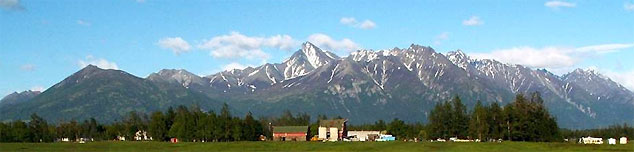
Matanuska Peak photo courtesy of Teressa Van Diest |